Narrative Theory:
Classical Hollywood Narrative:

1. It begins with equilibrium where everything is balanced.
2. An event happens which disrupts the equilibrium, causing a different change of events to take place.
3. The disruption is resolved and equilibrium is restored.
This theory is very helpful for understanding media texts due to the fact that a majority of narratives follow this same sort of structure and it is hard to find a narrative for a media text which does not. However, there are still a number of different narratives which go against this theory e.g. 28 Weeks Later (2007), Evil Dead 2 (1987), Halloween (1978), etc. The narratives of these films usually end on a depressing and sometimes disturbing note, usually leading to either a sequel or a dead end, leaving the audience wondering what happened after the film has ended. For example, the 1978 film ‘Halloween’ ends with the antagonist Michael Myers getting shot and falling off a balcony, supposedly to his death. However, upon discovering that his body is missing, the film suddenly cuts to creepy shots of all the locations where all the murders have taken place as Michael’s heavy breathing plays over the music. This shows that instead of having equilibrium restored, the disruption is still present. Not only that, but the disruption is still on the move and could appear again at any time to cause further problems for the equilibrium.
Character Types:
The term ‘character types’ refers to the many roles and narrative functions identified by Soviet folklorist, Vladimir Propp. These characters types consist of the following:
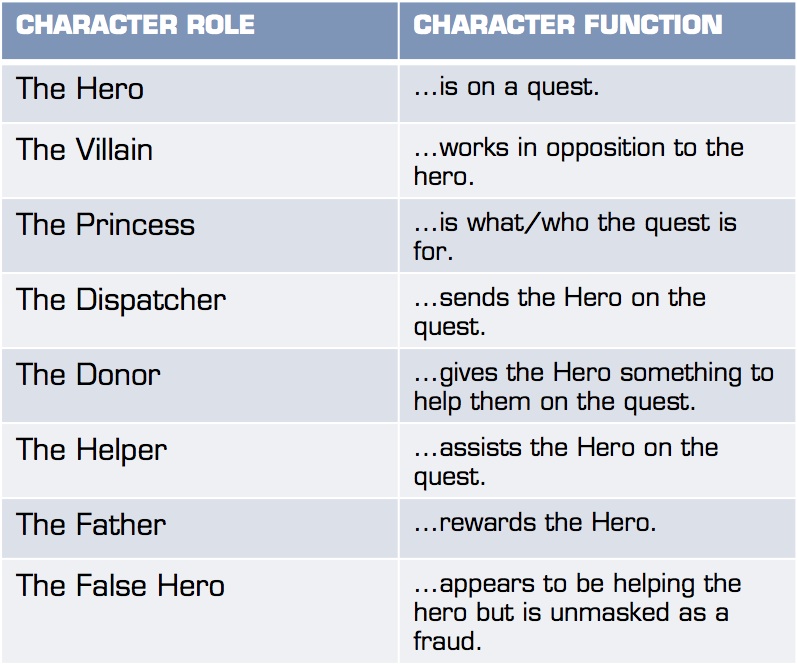
These character types are relatable to many media texts and are useful for understanding them since they all feature the same types of characters. Despite Propp identifying them from old folk tales, many of these character types have been carried over to modern-day films, television series’, novels, etc. For example, in ‘Halloween’, certain character types can be related to the characters featured in the film. First, Michael Myers certainly falls under the character types of Villain due to his role as the antagonist or the “event which disrupts the equilibrium”. Second, the main character Laurie Strode (portrayed by Jamie Lee Curtis) can be described as the Hero being that she is the main focus of the villain and is the character who will eventually fight against him in an attempt to restore the peace. And the third character, Dr. Samuel Loomis (portrayed by Donald Pleasence) can be seen as playing the role of the Helper. Despite not spending much time in the film alongside the hero, he assists with the fight against the villain during the climax.
Binary Opposition:
Binary Opposition is a term used to describe the sets of opposite values featured in most media texts and which reveal its narrative structure. These sets include the standard “Good and Evil” values which we obviously know are opposites. This term was studied by Levi-Strauss, a 20th century theorist who tried looking for more themes which could considered opposite values and also tried to find a deeper meaning for them. In today’s media, these themes are much more obvious than they were in the past and can be described in many different ways e.g.:
- Light/Dark
- Normal/Strange
- Poverty/Wealth
- Known/Unknown
- Youth/Age
- Noise/Silence
And these themes are even useful for understanding media texts since they can help define other types of narrative theory such as character types e.g. Good = Hero/Evil = Villain. These types of binary opposites are also present in ‘Halloween’, once again focusing around the main characters. These include:
1. Laurie Strode/Michael Myers = Good/Evil: one of the main focuses of the film which leads to the eventual climax.
2. Innocence/Corrupted = Due to Michael’s murderous nature, he can be seen as a mentally corrupted antagonist and an opposing threat to the innocent victims he slays. However, this theme could apply only to Laurie and the children she is babysitting since the other people he murdered seemed to be corrupted in different ways e.g. sex.
3. Male/Female = This set of binary opposites can be applied to Michael and Laurie’s conflict which takes place during the film. When ‘Halloween’ was first released, Laurie was one of the first examples of a ‘Final Girl’, the sole survivor of a Slasher film (usually female) who would eventually vanquish the villain or escape from them. This can also be relatable to how Laurie is seen as a virgin and take out her sexual frustration on Michael by using phallic weapons against him e.g. knitting needles, knives, hanger wire, etc.
4. Young/Old = Despite not being brought up as much, this is still a binary opposite which I feel needs to be addressed. Michael is portrayed in the film as being twenty-one while Laurie is portrayed as being seventeen. This could be relatable to the ‘Final Girl’ trope in which the younger female defeats the villain despite his age.
5. Dark/Light = Another set of binary opposites which is vague but still relatable to the film ‘Halloween’. During scenes set in the day, Michael is seemingly unable to attack Laurie due to witnesses and the fact that he could be arrested or killed by authorities. So it could be said that when the night falls, Michael has the advantage of being cautious and silent to kill his victims. Yet Laurie is able to fight back in scenes of the film where there is a larger amount of light present e.g. in the living room with the knitting needles, in the closet when she stabs him in the eyes, etc.
Bordwell and Thompson:
"A chain of events in a cause-effect relationship, occurring in time and space"
This was the quote by Kristin Thompson and David Bordwell, two film theorists who used it to define the term 'narrative'. From their viewpoint, they believed that a narrative begins with a situation which will eventually be interrupted by a series of events, most likely due to a pattern of cause and effect. Until finally, a new situation will take its place and end the narrative. As I have mentioned with previous narrative theories, this one can also be very helpful when trying to understand media texts since this can be related to many others. For example, in 'Halloween', when Dr. Loomis stops his car to investigate why the residents of the Sanatorium are wandering the grounds, this leads to Michael stealing it and escaping. And this eventually leads him going back to his old house, whereupon Laurie approaches the door and Michael sees her, leading to him stalking her until night-time. In fact, a number events sometimes happen off-screen as opposed to on-screen. One of them includes the death of a truck driver who Michael murdered in order to obtain his boiler suit. And another, probably the most popular one, is the scene where Michael's body disappears after supposedly falling to his death from a balcony.

No comments:
Post a Comment