1. How does the start exemplify a common technical code convention of the horror genre?
The opening scene of Halloween uses a lot of different technical codes to represent the horror film genre in an obvious way. First, the opening set at night, a key technical code used in a majority of horror films to make the audience feel scared since they cannot see where the antagonist could be hiding or what he could be seeing. Second, the scene uses both diegetic and non-diegetic sounds in order to create a scary ambience. For example, the sudden high-pitched noise when the upstairs light is turned off, Judith’s screams when Michael is stabbing her, the thuds heard when she is stabbed, etc. However, this scene also uses a lack of cutting to its advantage, despite fast-cutting being a well-known technical code in the horror film genre. This adds to the tension by letting the target audience see Michael’s point of view throughout the murder, including his slightly obscured vision as he innocently places on the clown mask.
2. How does the setting fit with the horror genre?
The setting for Halloween fits with the horror genre for a number of reasons. One of them being that it takes in a suburban neighbourhood, which connotes a false sense of security which will eventually be proven false by the arrival of Michael Myers and his killing spree. Also, the fact that this is an isolated community makes it a perfect location for the film to take place, making it hard for Laurie to get help or escape from Michael. Another would be that the film’s main events take place at night, an ideal time for when an antagonist in a horror film decides to kill his victims. Also, the fact that it is Halloween night adds to theme due to the night’s relation to dark subjects and to horror overall.
3. What iconography of “innocence” do we hear or see early on?
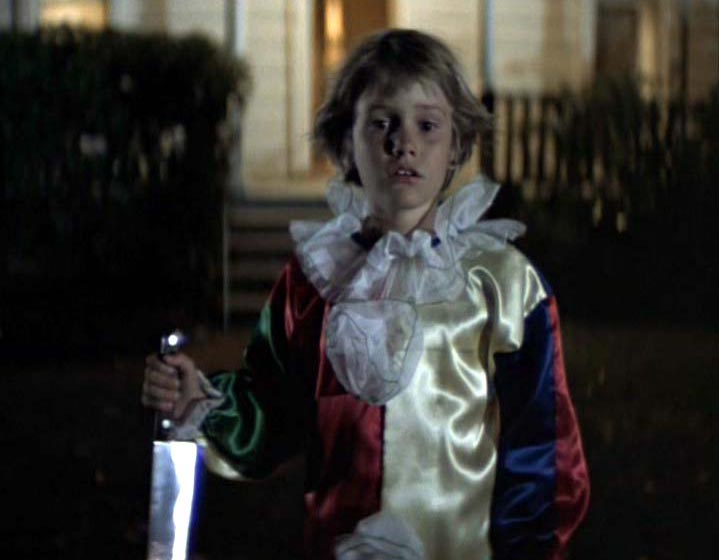
4. What was the main industry impact of Halloween?
Upon its release, 'Halloween' impacted the horror industry in a number of ways. First, it only had a low budget of only $325,000, yet still used inexpensive and effective ways of crafting their own costumes and props. In fact, Michael's classic mask was actually a customized Captain Kirk mask costing $1.98, spray painted white and given much wider eye holes. And despite these low budget effect and lack of big-screen stars, the film received critical acclaim the box office, earning back over $70 million. And due to this success, 'Halloween' has inspired many other 'Slasher' movies (Friday the 13th, Prom Night, etc.) as well as the classic 'Slasher' movie plotlines e.g. a traumatic event in the past creates a psychopathic killer, killer returns murders unsuspecting teenagers with "phallic weapon", etc.
5. Name some "Slasher" films which followed on from 'Halloween'.
 As I mentioned above, the success of 'Halloween' led to a number of new Slasher movies being released, following the same sort of events which revolve around the genre:
- Friday the 13th (1980)
- Prom Night (1980)
- My Bloody Valentine (1981)
- A Nightmare on Elm Street (1984)
- Graduation Day (1981)
6. What are the four plot rules of the "Slasher" film sub-genre which 'Halloween' began?
As mentioned in my previous questions, 'Halloween' became the inspiration for many other 'Slasher' movies, inspiring the running plotlines most films of the genre portray. These plotlines follow four rules which are constantly recycled, but still have a cult following due to their classic popularity:
1. A traumatic event in the past creates a psychopathic killer.
2. The killer returns to the site of the event, usually on a specific date in the present that allows the makers to use a calendar motif in the title.
3. The killer stalks and graphically kills a group of obnoxious and stupid teens of both sexes, usually with some kind of blade, often a garden or farm implement.
4. A 'Final girl' survives, usually boyish and often virginal, to thwart the killer, although he is never entirely vanquished.
7. Give three ways in which Laurie is androgynous.
 1. She has a name which can be applied to either gender e.g. Laurie, Billie, Jamie, etc.
2. She wears clothing which is seen as unappealing to her peers, almost tomboyish in appearance.
3. She is shown to have not be interested in dating guys, once again linking to her virginal characteristics of the 'Final girl' archetype.
8. What does the extract mean by "a reactionary sexual agenda"?
The quoted phrase used in the extract is describing the link between sex and death in the Slasher genre, more specifically 'Halloween'. This is referencing the fact that while the virginal Laurie survives the massacre that took place in the film, other characters who were sexualised in some way (e.g. Judith Myers, Lynda, Bob and Annie) were killed off by Michael while in pursuit of Laurie. It is noted that this sort of link was also referenced in the 1980 Slasher, Friday the 13th when young Jason Voorhees's death is blamed on the camp counsellors who were too busy at a party in the adult cabins.
9. How does the director, John Carpenter, counter the suggestion that 'Halloween' had a reactionary sexual agenda?
Despite claims that Michael killed his victims specifically because they had sex, the film's director, John Carpenter, replied by saying that "the main reason why the teenagers in 'Halloween' die is that they aren't paying attention". This could be a reasonable theory since, being teenagers, they are usually distracted by age-relevant issues such as sex and boyfriends/girlfriends.
10. Why does Michael Myers kill his sister?
 Many people and critics believe that the main reason behind Michael Myers killing his sister was due to Michael misunderstanding the scene of his sister having sex with her boyfriend. It is exemplified by the fact that Michael kills her with a phallic weapon and brutally imitates the action by "penetrating" her over and over again until she dies. However, Carpenter still states that this was not the reason behind Michael's killings or his psychosis. Instead it is said that the true reason is because Michael is pure evil, quoted by Dr. Loomis multiple times throughout the film.
No comments:
Post a Comment